
Online store · Shopify
Shmed
12,000+orders
A leading Ukrainian flavoured-honey brand. Shopify storefront, catalogue, and corporate and wedding gifting flows behind 12,000+ orders.
Taking on new projects
Business consulting & online growth
We build websites and automate workflows to help your business grow.
Free and without obligation. The €490 audit only if your task needs it.
We work with
Selected work
Stores, platforms and websites built around different business needs. Explore what we have delivered.
All projectsOnline store · Shopify
12,000+orders
A leading Ukrainian flavoured-honey brand. Shopify storefront, catalogue, and corporate and wedding gifting flows behind 12,000+ orders.

E-commerce · B2B CRM
10,000visitors a month with no ad spend
A leading Ukrainian cocktail-ingredients brand. E-commerce platform plus a B2B CRM with wholesale pricing, auto-replenishment for bars and clubs, and an interactive cocktail builder across 500+ SKUs.

Website · art club
Website for a live-music art club in Kyiv: event and bar showcase, booking integration and a photo gallery built around the venue's atmosphere.
Our tools
Besides client work, we build and run our own products. Open them and see how they work.
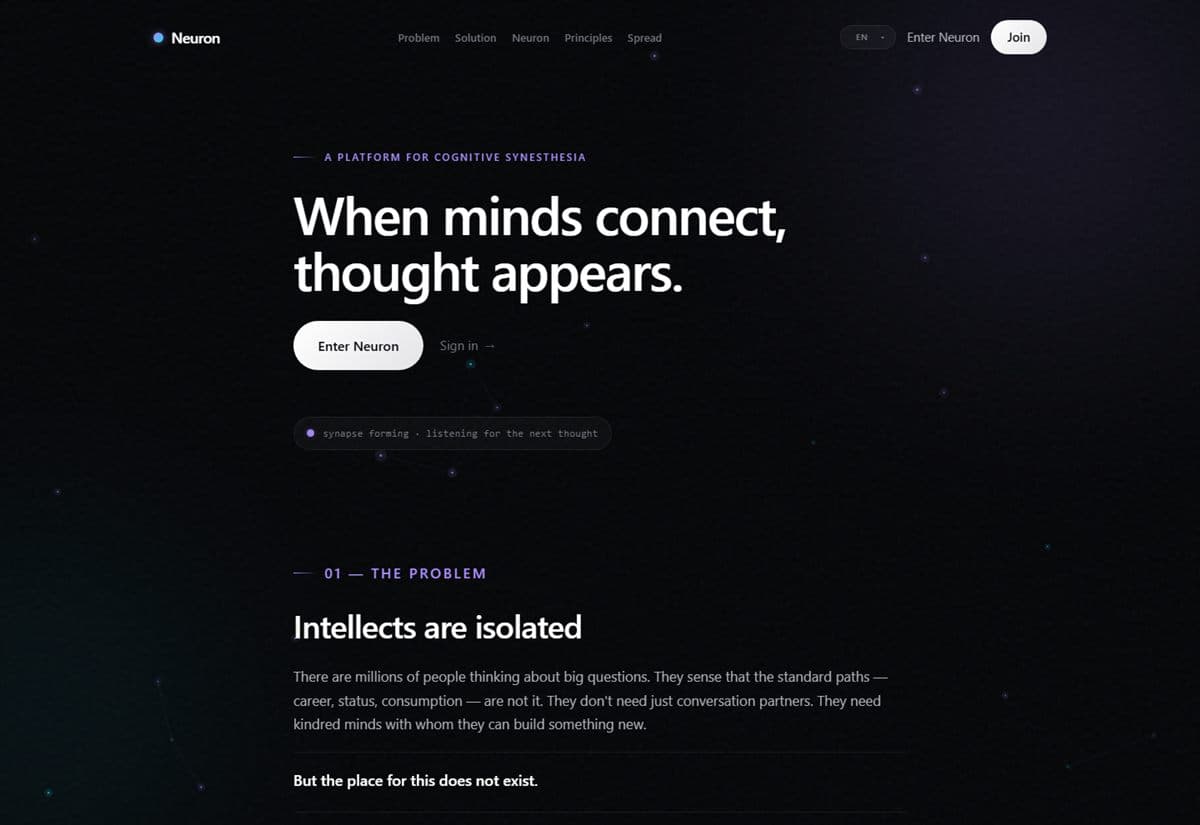
Platform · community
A discussion and knowledge-sharing platform for long-form, high-signal conversation: full community architecture, accounts and content structure.
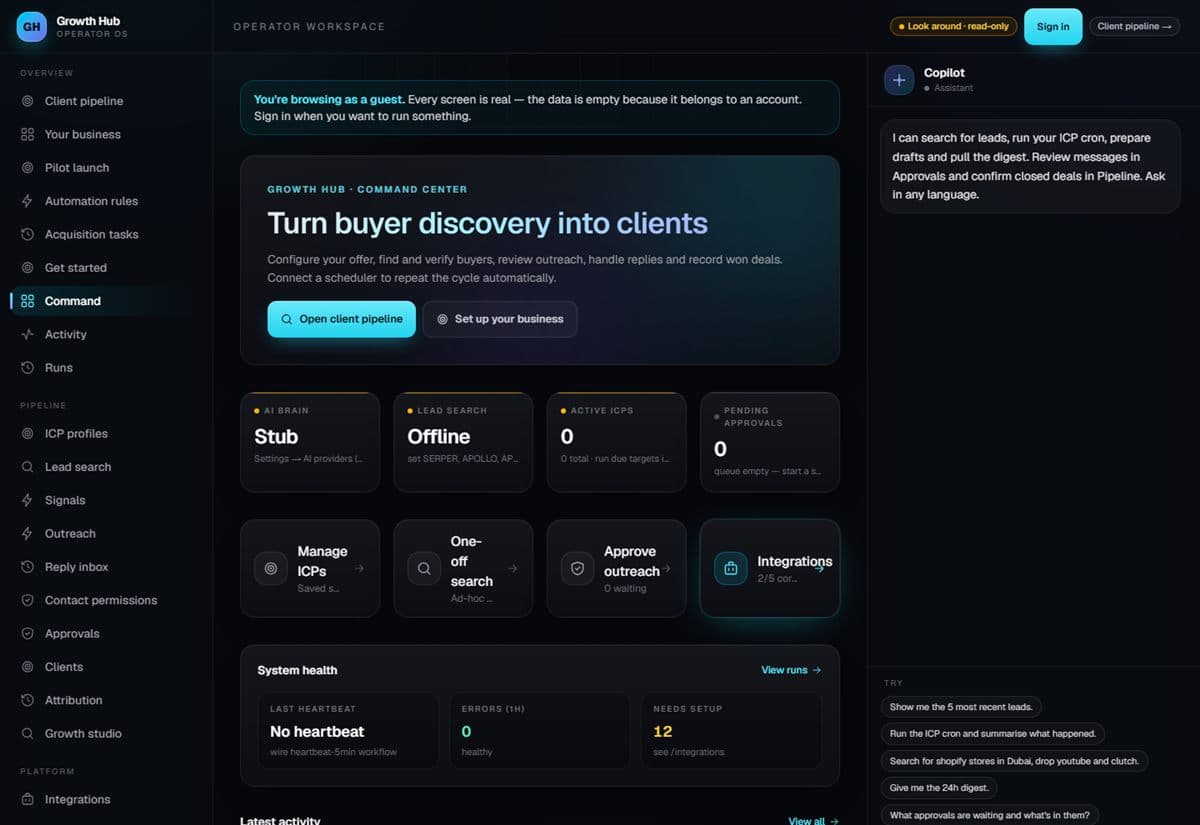
B2B platform · lead generation
A B2B lead-generation platform: encrypted lead search, pipeline tracking and a built-in AI assistant that qualifies and routes prospects.
When you need the full picture · €490 · up to 5 working days
A review of your website, SEO, sales channels and processes, an estimate of what is lost and a prioritised scope of work with prices. Take the plan to your team or another provider. If we implement it together, the €490 is credited toward implementation.
To get started: share your website address, describe your main growth goal or a difficult process, name the systems involved and share a sample enquiry or report without personal data. Do not send passwords in the form.
Illustrative report excerpt — not a client case study
Savings calculation: weekly enquiries × minutes saved ÷ 60 × hourly cost. Deduct service and maintenance costs. Figures are filled in only after measuring your actual process.
04 · Overview
Onravetoni is a business consulting and online growth team. Four service lines in one team: strategy and consulting, websites and web development, automation and CRM, SEO and organic visibility. Most businesses buy these from different contractors and stitch the pieces together themselves — the SEO agency blames the website, the developer blames marketing. We start with a free consultation: we work out the task and suggest what will pay back fastest. When the picture is unclear, a €490 audit measures every finding in hours and money. All access and work product stay yours.
Notes from the field
Set prices that cover costs and reflect value: calculate your floor price, compare the market, build packages and raise prices without losing good customers.
Read the articleA marketing plan on one page: target customers, offer, channels, budget and weekly numbers. A practical template for small firms, with a restaurant example.
Read the articleSet up Meta ads properly: Pixel and Conversions API with consent, the right objective, a local audience, creatives that stop the scroll and a fair test budget.
Read the articleStrategy and scaling — an audit, a 3–6 month growth plan, sales channels, unit economics and consulting for the owner. Websites and web development — landing pages, company sites, online stores and client portals that convert and are readable by search engines. Automation and CRM — enquiries in the CRM with source and owner, reports without manual work, systems in sync, standard replies and reminders. SEO and organic growth — a one-off turnkey setup: technical SEO, structure, meta tags, speed, structured data, Google Search Console and Business Profile, visibility in AI assistants.
No. The audit looks at all four because a problem in one area usually shows up in another — traffic without enquiries is rarely just a website problem. What you do with the findings is your call. Most projects start with one or two areas, in the order the audit ranked fastest to pay back. Each service can also be ordered on its own without an audit — for example, just a website or just the SEO setup.
The audit takes up to 5 working days, and you end up with measured findings and a plan whatever you decide next. A landing page goes live in 1–2 weeks, a company website in 3–5, the first automated process in 1–2 weeks. The SEO setup is a one-off job of 1–2 weeks; search rankings then usually grow over the following 2–4 months. We tell you which is which before you pay, not after.
The audit is €490, credited toward the first implementation within 90 days. Websites: a landing page from €600, a company website from €1,800, an online store from €4,000. Turnkey SEO setup from €450, one-off, no monthly fee. Automating a single process from €600, the automation package (3–5 processes) from €2,000. The full growth programme is €10,000 for 10–12 weeks. Consulting is €60 per hour; development and one-off support €30 per hour; a support subscription from €49 a month. The price is fixed before work starts and doesn't change.
You keep everything. Accounts, domains, code, workflows, dashboards and documentation are in your name from the start — we work inside your infrastructure rather than renting ours to you. There is no subscription that switches things off when it lapses, and no piece that only we can maintain. If you leave, the next team gets a documented system instead of a black box, which is the main reason we write the documentation as we go rather than at the end.
Next step
We look at your task and tell you what will pay back fastest and what it costs. If you need the full picture first, the €490 audit gives you a costed plan in five working days and is credited toward implementation.
01 · What holds growth back
Six situations that cost a business clients and burn hours every day.
Traffic arrives, but the site is slow on mobile, the form is confusing and the offer doesn't answer the buyer's questions. People leave for competitors.
How we fix itCompetitors sit on page one and in AI-assistant answers, and you don't. Every client comes through ads you pay for again and again.
How we fix itA form on the site, an email, a Telegram message, a phone call — and someone enters it into the CRM manually. Some requests are lost simply because a manager was busy.
How we fix itMonth end arrives and two days go into exports, merging spreadsheets and hunting for errors. Every month, from scratch.
How we fix itMoney goes into ads, the website and contractors, but nobody can say which channel brings clients and which just burns budget.
How we fix itVolume grows, so another manager is hired for the same routine. Costs scale linearly and the process stays just as fragile.
How we fix it02 · Services
An online business audit, a 3–6 month growth plan, sales channels and unit economics. We find what is holding growth back and calculate what will pay off most.
Landing pages, company websites and online stores that sell: fast, responsive, with forms wired into your CRM and a technical foundation ready for SEO.
Enquiries land in the CRM on their own, reports build themselves, systems stay in sync and standard replies go out automatically. Your team works with clients instead of copying data.
A one-off turnkey setup: technical audit and fixes, structure and meta tags, speed, structured data, Search Console, Google Business Profile and visibility in AI assistants.
03 · How we work
A free call: we work out the task and what will pay back first. If the picture is unclear, the €490 audit reviews the website, traffic, SEO, sales and processes and gives you a growth plan with prices, ranked by payback.
We do what pays back first: a website that sells, SEO setup, automation of enquiries and processes, CRM integration. The price is fixed before we start.
We hand over documentation and access and show your team how everything works and what to do if something breaks. The website, accounts and processes are yours — no lock-in.
Once the foundation is in place, we add the next steps: new sales channels, lead generation, new pages and markets. Strategy consulting whenever you need it.